Before the First Day
I've been to Mexico more times than I can count, and I had never been to Mexico.
Cancún. Playa del Carmen. Puerto Vallarta. Swim-up bars and plastic wristbands, a country sanded down, deboned and served poolside with a little umbrella in it. Nothing wrong with that. I've enjoyed every minute. But it's Mexico the way a theme park is a city: pleasant, frictionless, and about as Mexican as the buffet's idea of a taco.
So when my sister and I decided we wanted to travel together, with her boyfriend Scot along for the ride, the capital was the obvious call. Everyone whose opinion I trust said the same thing about Mexico City, always with the slightly glazed, evangelical look of a convert: the food. We rented an apartment beside Chapultepec Park and pointed ourselves at the real thing.
The real thing, it turns out, does not give a damn about your schedule.
This is a city where the map lies to you with a perfectly straight face. Your destination looks like a pleasant stroll. You call an Uber. Then you sit. And sit. Twenty-odd million people, all trying to get somewhere at once, and you're just one more body in the bloodstream. Horns. Vendors walking between the lanes. Motorbikes threading gaps that do not, by any law of physics, exist. Somewhere around minute forty, you understand: "close" in Mexico City isn't a distance. It's a philosophical position.
And we'd landed days before the World Cup kicked off. Police out in force. Protestors out in force. Roads closed without warning or apology. Annoying? Sure. But it gave the whole place a low, electric hum, the feeling that something was about to happen. Usually, something did.
June 6, 2026 · Mexico City
Day 1: Marble and Masks
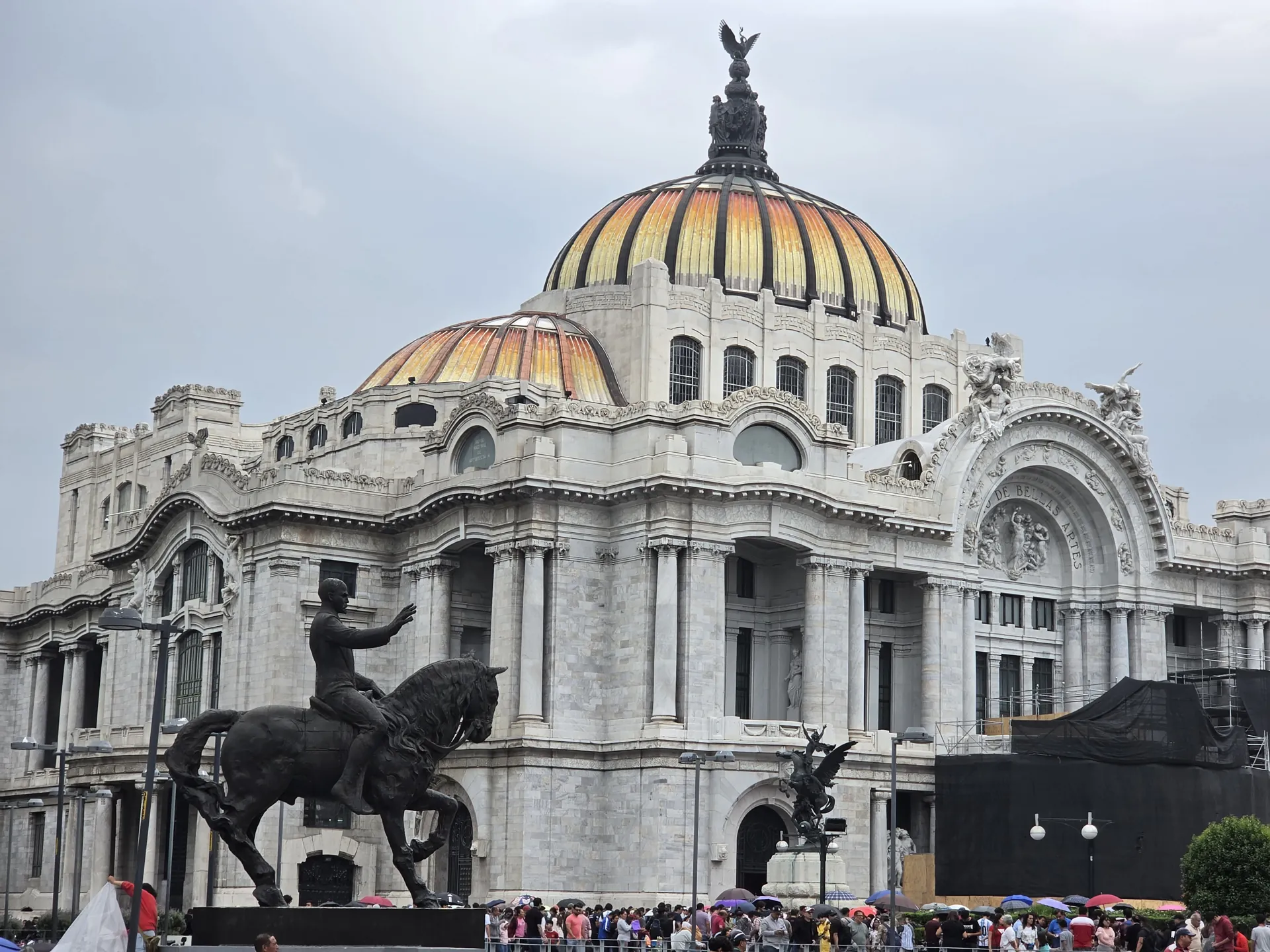
The Palacio de Bellas Artes is the city in its Sunday best: white marble, wedding-cake ambition, a dome glowing over the historic centre like it's very pleased with itself. It took decades to finish, held up in the middle by a revolution, which feels about right. This is a country where even the opera house had to survive a war.
Inside, you crane your neck at the ceiling until your spine files a complaint. Outside, the city roars on, completely indifferent to beauty, too busy being itself to notice.
But the night belonged to lucha libre.
If you want to understand a place, skip the monuments and go where the locals scream. Lucha libre is theatre, sport, morality play and family night out, cranked to the volume of a jet engine. Masked heroes. Masked villains. Grandmothers hurling abuse with real conviction. A crowd that knows exactly who is good and who is evil, and has no intention of keeping that opinion to itself.
Our seats were right beside the point where the wrestlers walked down to the ring. Close enough that as these enormous, glittering, masked men came past, I was slapping high fives like an eight-year-old at his first ballgame. I would like to report that I played it cool. I did not play it cool. Not for one second.
There are rare moments on the road when you stop observing a culture and simply get swallowed by it. This was one. Nobody in that building was being ironic about anything. For two hours, neither was I. It was the most honest fun I'd had in years.
June 7, 2026 · Mexico City
Day 2: The Stone That Counts the Ages
The Museo Nacional de Antropología, in Chapultepec, is the kind of place that makes your own civilization feel like a recent rumour. A rough draft. Something we're still working out.
You walk into the courtyard and meet El Paraguas: a single colossal column holding up a vast roof, water pouring down from above like a permanent rainstorm someone decided to bring indoors. It's absurd. It's magnificent. It tells you, before you've seen a single artifact, that this country thinks on a different scale.
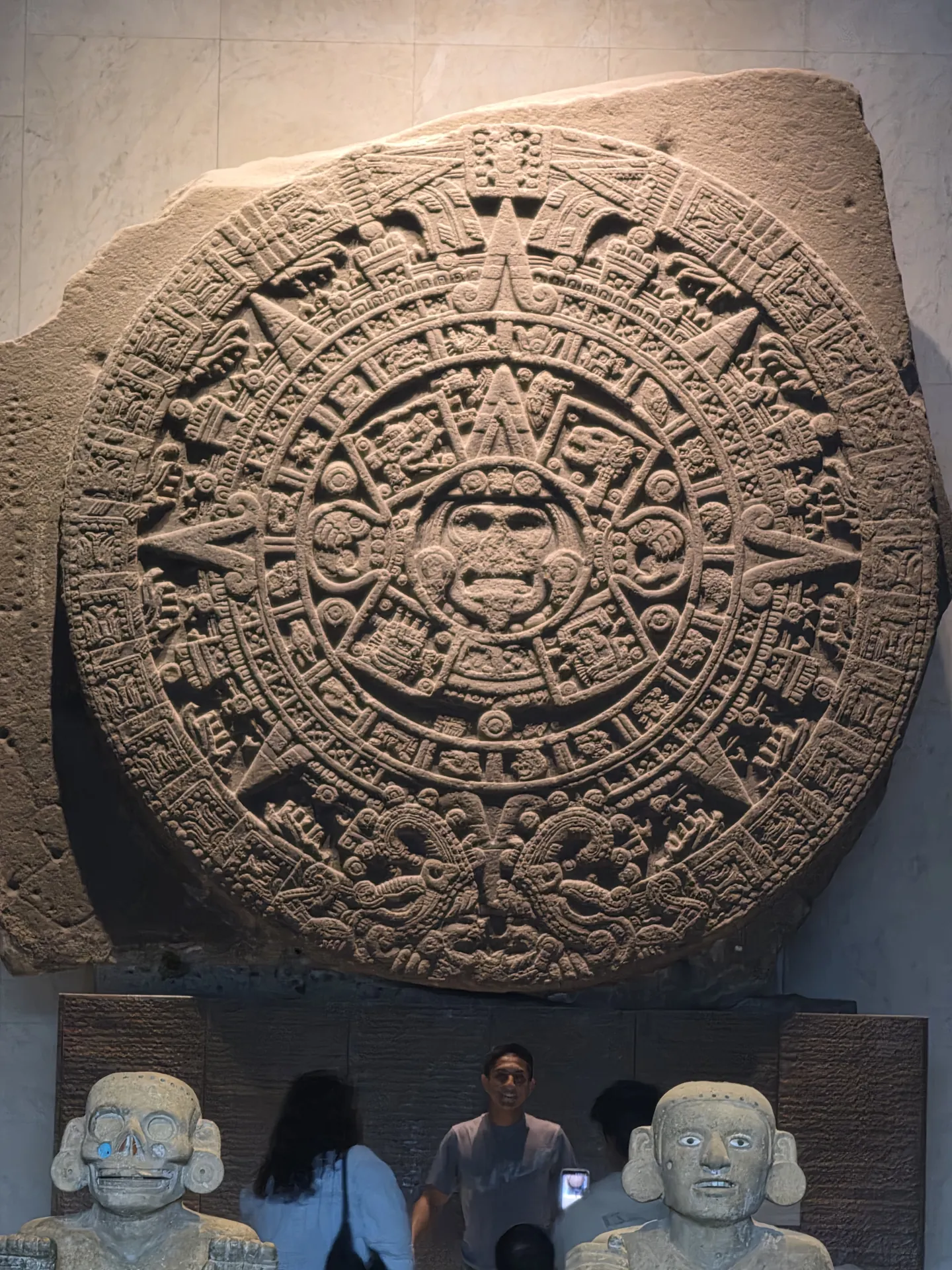
Then the Piedra del Sol. The Sun Stone. More than twenty tonnes of carved basalt: a calendar, a cosmology, a statement about time and blood and the order of the universe, all carved by people who believed the sun needed feeding to keep rising. It lay buried for centuries until 1790, when workers repaving the city's main square hit it with their shovels. Think about that. You're just fixing the road, and you dig up an entire worldview.
That's the thing about this city that gets under your skin. It sits on top of Tenochtitlan, the Aztec capital, a city of canals and temples built in the middle of a lake. The Spanish tore it down and built their own on the rubble. Then they drained the lake. And now the whole damned place is sinking, slowly, into the soft old lakebed, centimetre by centimetre, as if the past is quietly pulling it back under.
You don't visit history in Mexico City. You stand on it. And it moves.
June 8, 2026 · Teotihuacán
Day 3: Above the Place Where the Gods Were Born
Somewhere around four in the morning. Apparently this is what I do for fun now.
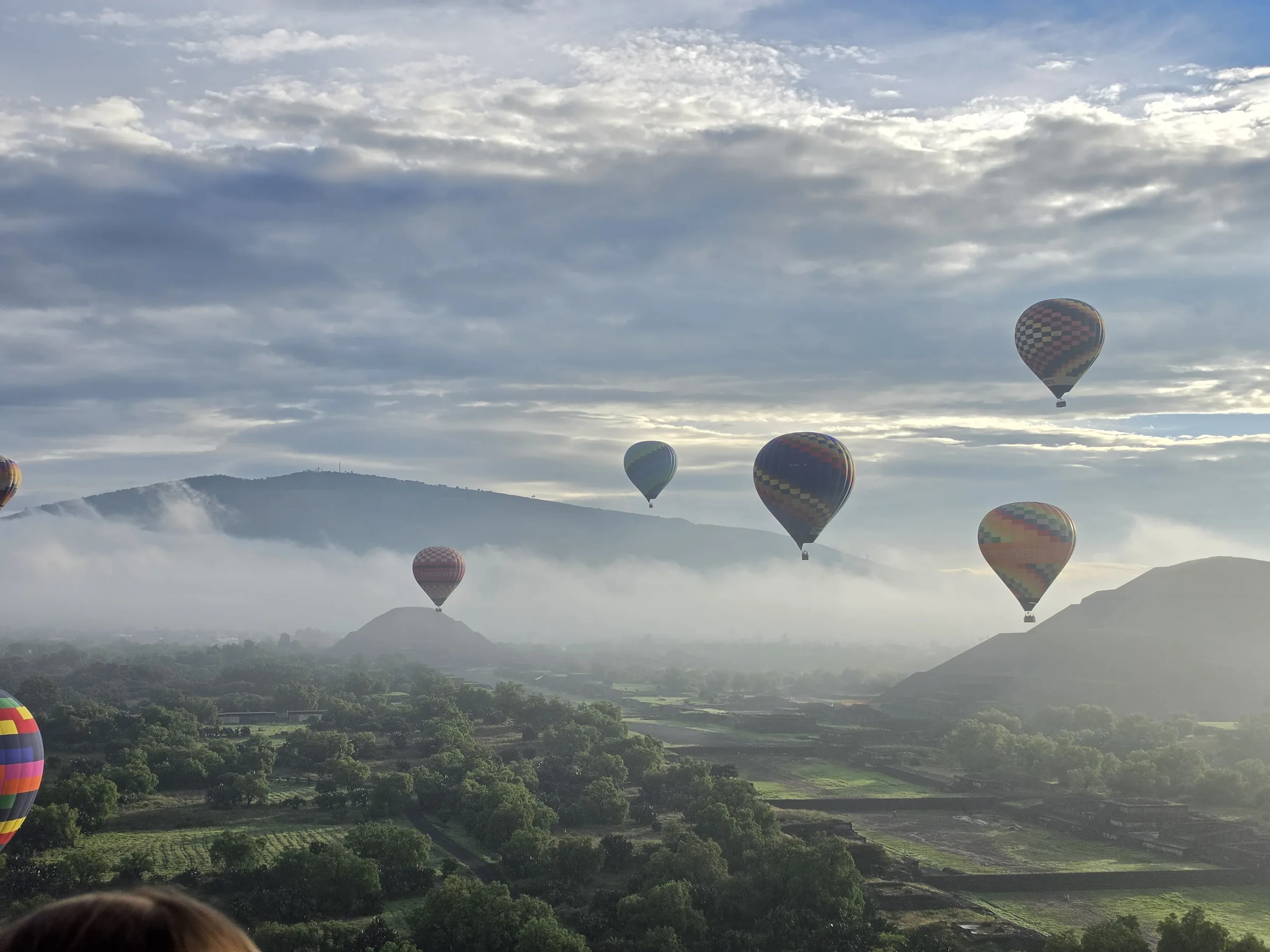
I think we were out of the city by five: half-asleep, under-caffeinated, heading northeast to Teotihuacán, about 50 kilometres out. The plan, if you can call it that, was to climb into a wicker basket, attach it to an enormous bag of hot air, and float over a ruined city that was ancient before the Aztecs ever laid eyes on it.
I should mention I don't love heights. On paper, this was a deeply questionable arrangement.
And then: nothing. No lurch. No terror. The smoothest, calmest thing I'd done all trip. Just a slow, silent rise into a sky full of other balloons, low clouds hanging over everything and turning the whole scene into a fever dream. And below us, the pyramids, sitting in the early light, enormous and patient, with not a single tourist on them. Just stone. Mist. Time.
By the time the Aztecs found Teotihuacán, it was already abandoned: a city that, at its height, had held more people than most of Europe's capitals. They had no idea who built it. So they gave it a name: the place where the gods were born. Hanging up there in the haze, looking down on it emptied and silent, you get it immediately. People didn't build this. Gods did. Or people who wanted very badly to be gods, which may amount to the same thing.
Later, back on solid ground, we walked around the pyramids with that aerial view still burned into our heads. From above, it had all made sense: the geometry, the intention, the sheer, arrogant nerve of it. From down here, the stones loom over you, and you feel very small, and very temporary.
Which, to be fair, is accurate. It's good to be reminded every now and then.
June 9, 2026 · Mexico City
Day 4: Castles and Shelves
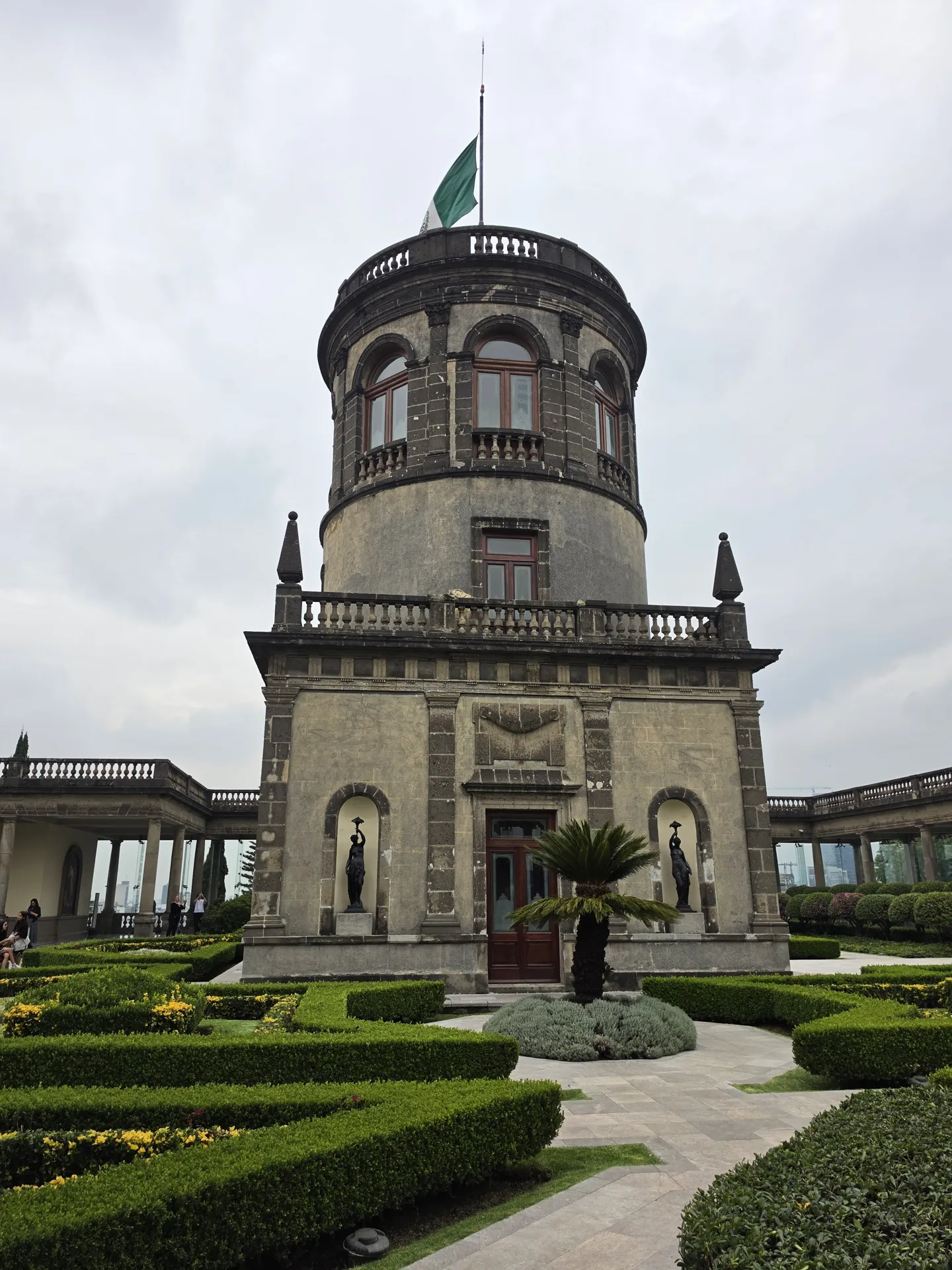
Chapultepec Castle sits on its hill above the park, gazing down at the city as if it still expects to be obeyed. Emperors lived here. Presidents too. The gardens and the tower carry that faded, slightly melancholy grandeur of a place that has outlived several ideas of who ought to be in charge, and seems a little tired of watching people try.
Then, in the evening, the Biblioteca Vasconcelos: a library that looks like someone designed it after a very good dream, or a very strange one. Bookshelves hang in mid-air, stacked and floating through a vast cathedral of steel and light. It makes you want to sit down and read something important. Or at least to be photographed pretending to.
The three of us wandered through it together, and it hit me that this, more than any pyramid, was the whole point. My sister, Scot and me. A few days in a city none of us knew, getting lost together, figuring it out side by side. You can watch Teotihuacán in a documentary. You can't download that.
June 10, 2026 · Mexico City
Day 5: The Market
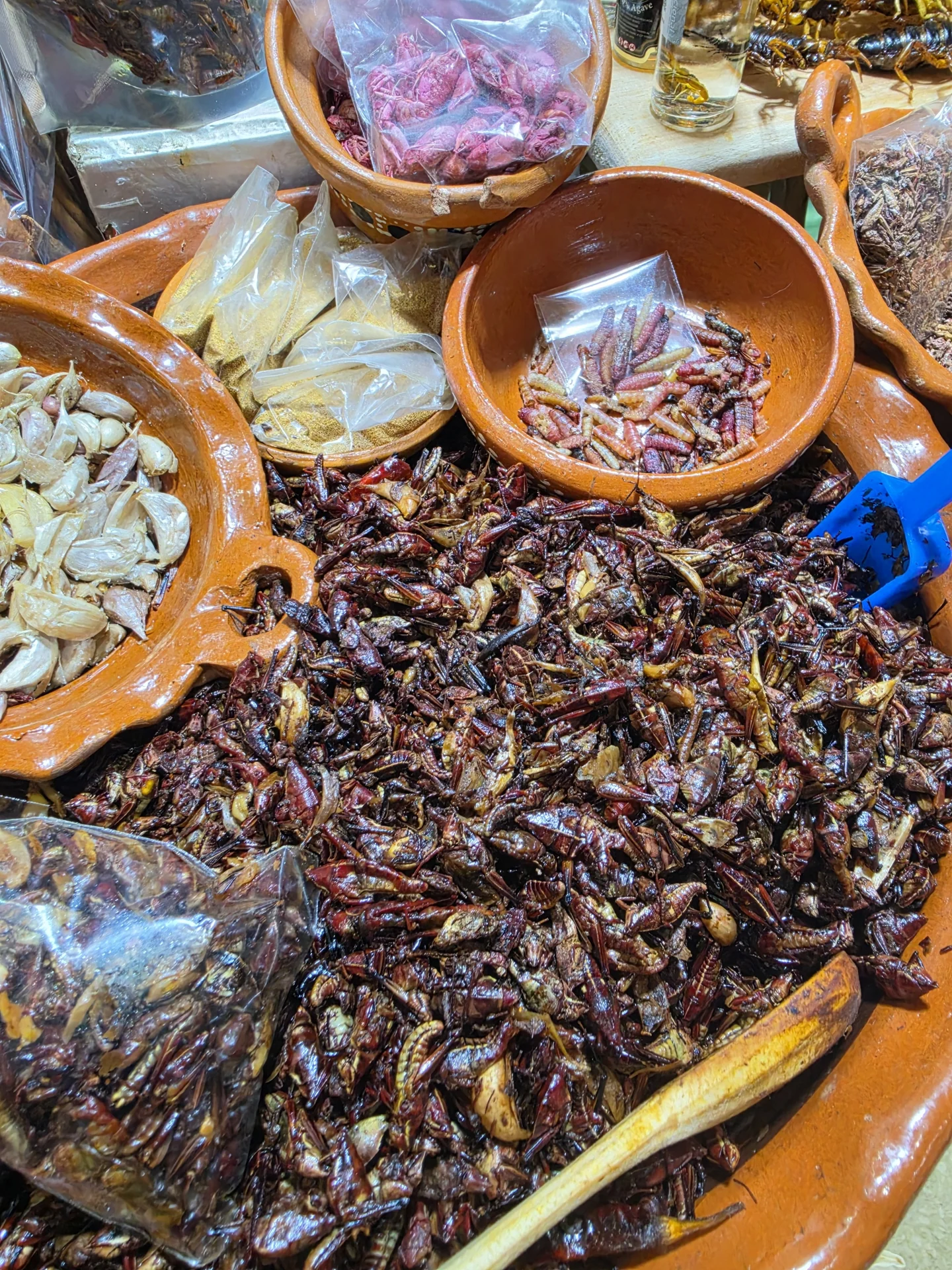
Then the market.
Every city has a front door it shows the visitors, and a kitchen where the truth gets told. The market is the kitchen. I walked through aisles of ingredients I couldn't name, mountains of chiles and things I didn't recognize, and then, there they were: insects. Bugs, piled up as food, sold as matter-of-factly as onions.
A part of my brain, the part raised on supermarkets and shrink-wrap, flinched. The rest of me knew better. People have been eating insects in this valley since long before anyone thought to build a cathedral here. It's protein. It's tradition. It's dinner. The only thing strange about it was me.
That's a market telling you the truth about a place. It isn't putting on a show for you. It's feeding people the way they've been fed for centuries, and it doesn't need your approval. Never did.
What I Carried Home
The micheladas. My god, the micheladas. Beer, lime, salt, chili, spice, in more permutations than any reasonable person needs to sample. They're one of my favourite drinks on earth, and Mexico City treats them as a basic human right. I made it my mission to investigate. Thoroughly. Repeatedly. Wherever I went. For science.
I came to Mexico City looking for the country the resorts had been hiding from me. What I found was a city that's loud, sinking, gridlocked and glorious, built on the bones of empires and still arguing with itself in the streets. It didn't care whether I liked it. It didn't need me to.
It wasn't close. It wasn't easy.
It was exactly what I came for.