A travel journal
The River That Confiscated My Sense of Proportion
July 26–August 1, 2026
Enter the journalThere is a type of traveller who comes home from the rainforest with an epiphany, fully assembled and ready for delivery at the first dinner party, and I wish it understood from the outset that I do not belong to that company. What I brought back from the Amazon is a smaller and, I suspect, sturdier cargo: a handful of particular things seen, a run of very good lunches, and a series of firm corrections to my sense of scale. The river confiscated that sense on the first day, much as a customs officer relieves a passenger of an undeclared apple, and without so much as a receipt.
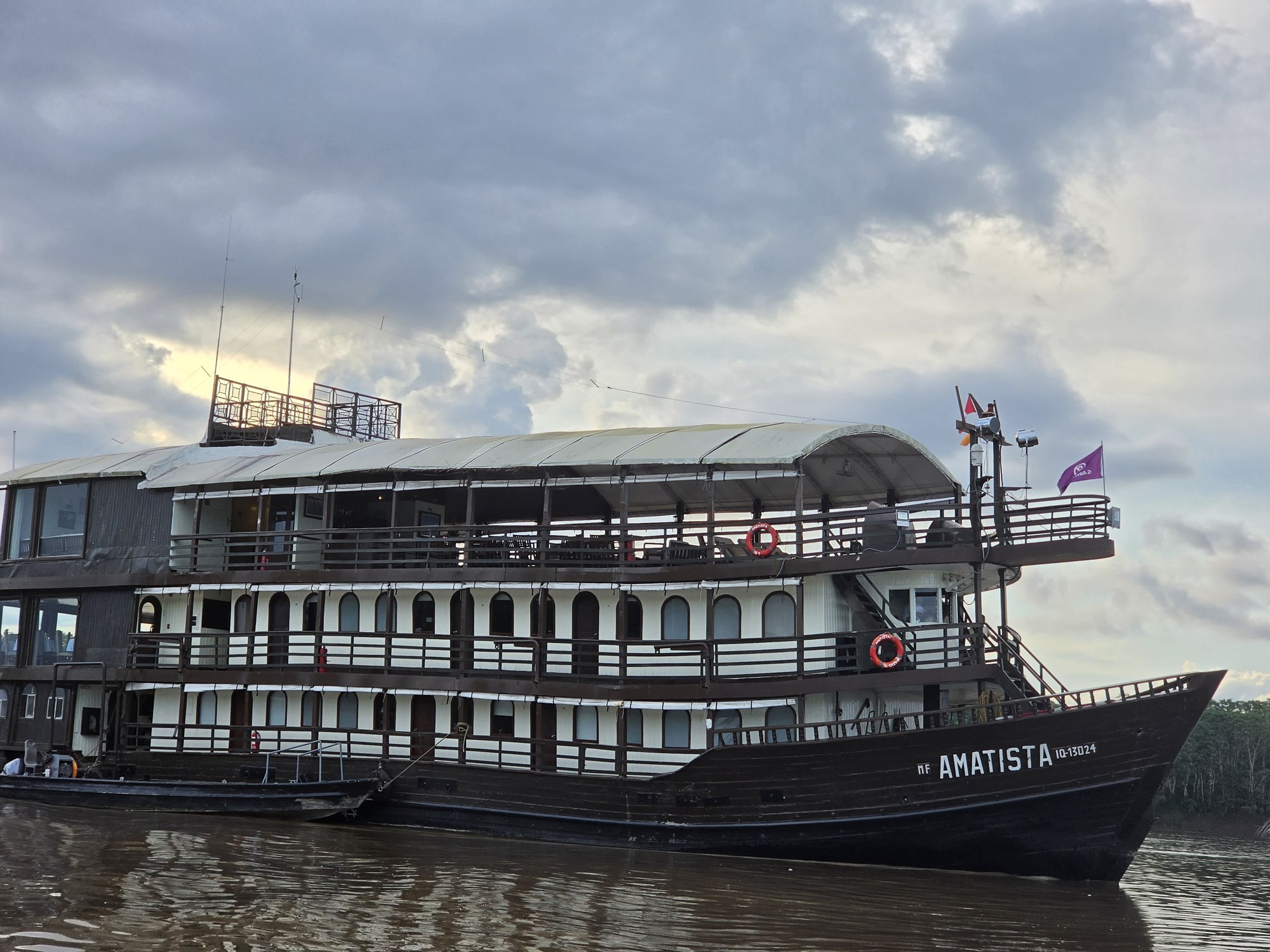
We spent the week aboard the Amatista, among an interesting crowd of fellow travellers and under the direction of guides whose gift for finding animals verged on the unsporting. On one memorable morning, breakfast arrived with pink dolphins all around. A brochure would have invented it, and no self-respecting brochure would have dared. I should love to report that I rose to the occasion. I ate my breakfast. The dolphins carried on with their business, and the arrangement suited everyone.
The Amazon is wider, longer and more thoroughly occupied than “big” can responsibly be asked to cover. Everything on it is busy with its own affairs, and none of it is waiting on an audience. Some days turned on something tiny, some on something enormous, and one, I will not rush it, on an anaconda.
Sunday, July 26, 2026
Day 1: A Fish That Outgrew Its Noun
Language was the first casualty, and the arapaima was the cause. “Enormous” presented itself at once and proved perfectly accurate and almost entirely useless, rather like being informed that the ocean is wet. “Fish,” a serviceable noun for most of my life, suddenly resembled a hat that someone had asked a much larger head to wear. I have no measurement to offer, only the lasting impression of an animal that had comfortably outgrown its description. Gulliver had to sail to Brobdingnag to feel that small. I managed it on the first day, and without the paperwork.
The capybaras made their case by a different route. They were absurdly, indefensibly cute, which turns out to be a complete argument requiring no supporting evidence. The birds, parrots among them, argued from colour, and the colours were stunning. I record the word without trying to improve on it.
So the arrangement of the week was laid out on the opening day, without announcement or ceremony. Nothing was going to arrive one at a time. No attraction would wait politely while the visitor found his bearings. The place was already in full swing when we got there, and it did not stop.
Monday, July 27, 2026
Day 2: The Ones Who Miss the Poster
There is a temptation, when a day’s sightings are gathered up, to file them all under one heading, “wildlife,” as though the creatures had met beforehand, struck a committee and agreed to share a programme. The group’s day argued the contrary. Monkeys, birds, a coati, a stingray, a stick insect and giant water lilies were among what the group saw, and no two of them seemed to be conducting the same sort of life.
Consider the water lilies, who are rarely extended the courtesy. In the usual hierarchy of a nature outing, animals are promoted to events and plants are left as scenery. A giant water lily declines the demotion. It is a very hard thing to leave in the background, and it belonged to the cast of the day as fully as anything with a pulse.
The stick insect is the subtler case, being a creature whose entire professional strategy is to go unnoticed. When somebody spots it, the strategy has failed, and one can only admire the spotter. That was the quiet lesson of the guides, who were remarkably good at it all week. To know that life is everywhere is easy and costs nothing. To see it takes practice.
The coati and the stingray belong to the class of sightings that get lost between the headline animals, and they are exactly the ones that make a day feel inhabited rather than merely exhibited. And some of the monkey activity was heard rather than seen, a useful reminder that most of what happens in a forest happens whether or not anyone has bought a ticket.
Tuesday, July 28, 2026
Day 3: Gold, and a View from Above
The butterfly cocoon looked like gold. I note for the record that it was a cocoon at a butterfly farm and not bullion, but it would have sat comfortably in a jeweller’s window. Nature, it appears, keeps its own metalwork shop and sees no need to advertise.
That day I also flew my drone, and the drone drew a crowd. Village children and some of the men huddled around me, watching themselves and their village from above. The children waved, smiled and ran after it. As pilot, I was left with the dignity of the controls and very little else.
Travel is ordinarily a one-way street. The visitor does the looking, and the resident does the being looked at. For a short interval, the drone sent that arrangement in for repairs. The village was the subject, and the people who live in it were among those watching, looking down on their own home from a height. Most of that week I was the one looking. For this stretch I held the controls, and a good many other people were looking too.
Wednesday, July 29, 2026
Day 4: Lunch, with Dolphins in Attendance
We ate our picnic lunch on an explorer boat with pink dolphins all around us, and I would like to insist on the preposition. “All around” is not “somewhere off in the distance.” Dolphins at a distance are a sighting. Dolphins all around are a change in the nature of the meal, which stops being lunch and becomes something nearer to an engagement.
Some occasions defeat the writer who sets out to describe them, and this was one. A boat, a picnic, pink dolphins: the ingredients did all the work, and my contribution was to eat. I am entirely at ease with that division of labour.
Boat lunches in general were very good that week, and a highlight of it, which is a serious distinction in a week that also contained an arapaima. I take it as a compliment to the lunches and no insult whatever to the arapaima.
In the boat alongside mine, another member of our group was aboard with the driver’s pet monkey. I watched from my own.
Every visitor packs a cultural lens. It weighs nothing, which is its chief danger, since it can quietly take over half the view. I tried to keep mine in its case and look first. The words “pet monkey” invite a traveller to begin drafting a verdict, and any verdict I drafted would have been composed entirely from my side of the water, which is a poor vantage from which to rule on the other. What I knew was small: the monkey belonged to the driver. The larger questions about people and animals deserved rather more than a ruling from the next boat over.
Thursday, July 30, 2026
Day 5: The Argument Before the Meal
Most meals arrive with the labour edited out. The work was done somewhere else, by somebody else, and the dish appears before you like a conclusion with the argument deleted. At Monte Alegre the argument was the main event.
We watched people cook communally. The ingredients, the preparation and the business of making a meal together were all there to be followed, and only then was the food served. It is not often one is permitted to read a meal from the first page.
The menu ran to piranha, paca, catfish and plantain, with a banana smoothie, passionfruit juice and masato. Paca was the unfamiliar name on the list. We were told it was a kind of rodent, which narrowed the field without settling anything, in the manner of a witness who will say only that the suspect was a person. What counts as food is decided by those who live in a place and not by whoever happens to pass through. A menu on which you recognise everything teaches you very little. This one, at least, came with a question.
I thought it a good menu, and the preparation was interesting. What I liked best was knowing how the meal had come to exist. Cooking in company is among the most ordinary ideas people have ever had, and still it was the part of the day that held my attention. A meal you have watched come together arrives with its history attached.
Friday, July 31, 2026
Day 6: An Anaconda, a Piranha and a Toast
The thirty-first of July had a puddle in it, and the puddle had an anaconda.
Vincent grabbed it. He did not know what he was going to grab.
Most travel is organised against surprise. We read ahead and book ahead and ask what a thing is before it has properly arrived, and the whole apparatus of the modern itinerary exists so that nothing need ever be grabbed unidentified. I saw the anaconda myself. It still sounds like an exaggeration.
My own dealings with wildlife that day were humbler, and they turned to fishing. Watching animals asks only for attention. Fishing asks for results. Until then, being interested had been a perfectly respectable contribution to the week, and the piranha appeared to be holding out for more.
The others in our group caught theirs sooner. I really struggled, and I was among the last to catch one. From the outside, patience looks like a virtue. From the inside, it looks like not catching anything.
Then I caught one. As I remember it, it was the biggest piranha the group caught that day, and I felt a little vindicated, a modest portion served well behind schedule. It is remarkable how quickly a man revises the terms on which he wishes to be judged once the fish is the biggest.
At sunset, there was a champagne toast. A glass raised in a place that had spent the week making human gestures look small might easily have felt ridiculous. It seemed instead a fitting way to mark the week.
Saturday, August 1, 2026
Day 7: The River Keeps Its Own Counsel
On the last morning, we left the Amatista and returned to Lima for one final night. The river portion of the trip was over. What stayed with me was less obedient to the itinerary.
What Stays
Some of the week belongs to no single date. Giant tarantulas were part of it, and so was the sheer density of the jungle, where life seemed to be going on everywhere at once. So were the guides, who were excellent at finding animals and knew the history of the Amazon besides. The animals did not announce themselves, and the guides found them anyway. That is the difference between seeing a river and seeing what lives along it.
Along the river I saw people bathing and catching food, and a young boy with pet birds perched on his shoulder. To me it looked like a different connection with animals. I tried not to lay my own assumptions across it, and I have not tried to turn it into a lesson since. The boy and his birds, like the driver’s monkey in the neighbouring boat, were glimpses, and a glimpse is a thin foundation for a theory.
The company mattered too. The Amatista carried plenty of Americans and Canadians, an interesting crowd to share a vessel with. My roommate was a man in his sixties who had once been a police officer in England. We were different in some ways, and we made sharing a room work, which on a boat is a small achievement and a considerable convenience.
If the week taught me a habit, it was to let a thing be what it is before explaining it. A cocoon looked like gold, and that was the fact. A pet monkey was in the next boat, and that was another. The explanations I was tempted to add were chiefly mine, and they could wait.
The week was unlike anything I had done before, and I came away wanting another of its kind: adventure river cruising, with good guides, very good lunches and people worth meeting. The river took my sense of proportion on the first day and made no offer to give it back. I have not filed a claim. Another week on the river? I could be persuaded.